How Allen Put an AI Qualification Layer at the Top of Its Inbound Funnel

Our Impact
Our Impact
- 80% of queries resolved without a counsellor entering the thread
- 3× lower cost per inbound lead, versus the pre-deployment baseline
- One agent, two systems: course database and CRM, read and written in real time
Company Overview
Allen is one of India's leading coaching institutes for JEE and NEET, the entrance exams that decide admission into the country's engineering and medical colleges. It's a category built entirely around admission cycles: interest spikes hard around exam and application windows, and every one of those windows tests whether the institute can turn inbound volume into enrolled students before the cycle closes.
The nature of that inbound volume is the hard part. On any given day, Allen's WhatsApp line hears from a Class 9 student's parent just starting to research options two years out, a Class 11 student actively comparing programmes, a Class 12 student ready to enrol this cycle, and people who reached the wrong number entirely, wrong class, wrong stream, wrong city. All of them arrive through the same channel, land in the same queue, and get picked up by the same counsellor, with nothing in the funnel to tell which is which before a human is already on the line.
Challenge: No Filter at the Top of the Funnel
Every inbound lead, across paid, organic, referral and walk-in, passed through to a counsellor with no qualification step in between. Discovery happened on the call itself, meaning counsellor time went into conversations that were never going to convert this cycle just as often as ones that were.
That structure held up until admission season, when volume peaked. Backlogs grew, the response window widened, and lead-to-callback latency increased across the day. Students who were genuinely ready to compare and enrol sat behind earlier-stage leads that weren't. Marketing spend kept flowing in, but the labour cost of turning that spend into a delivered conversation kept climbing.
The shortfall wasn't a counsellor performance problem. It was architectural: the funnel had no mechanism for separating a serious buyer from someone still exploring.
Solution: An AI Agent at the Top of the Funnel
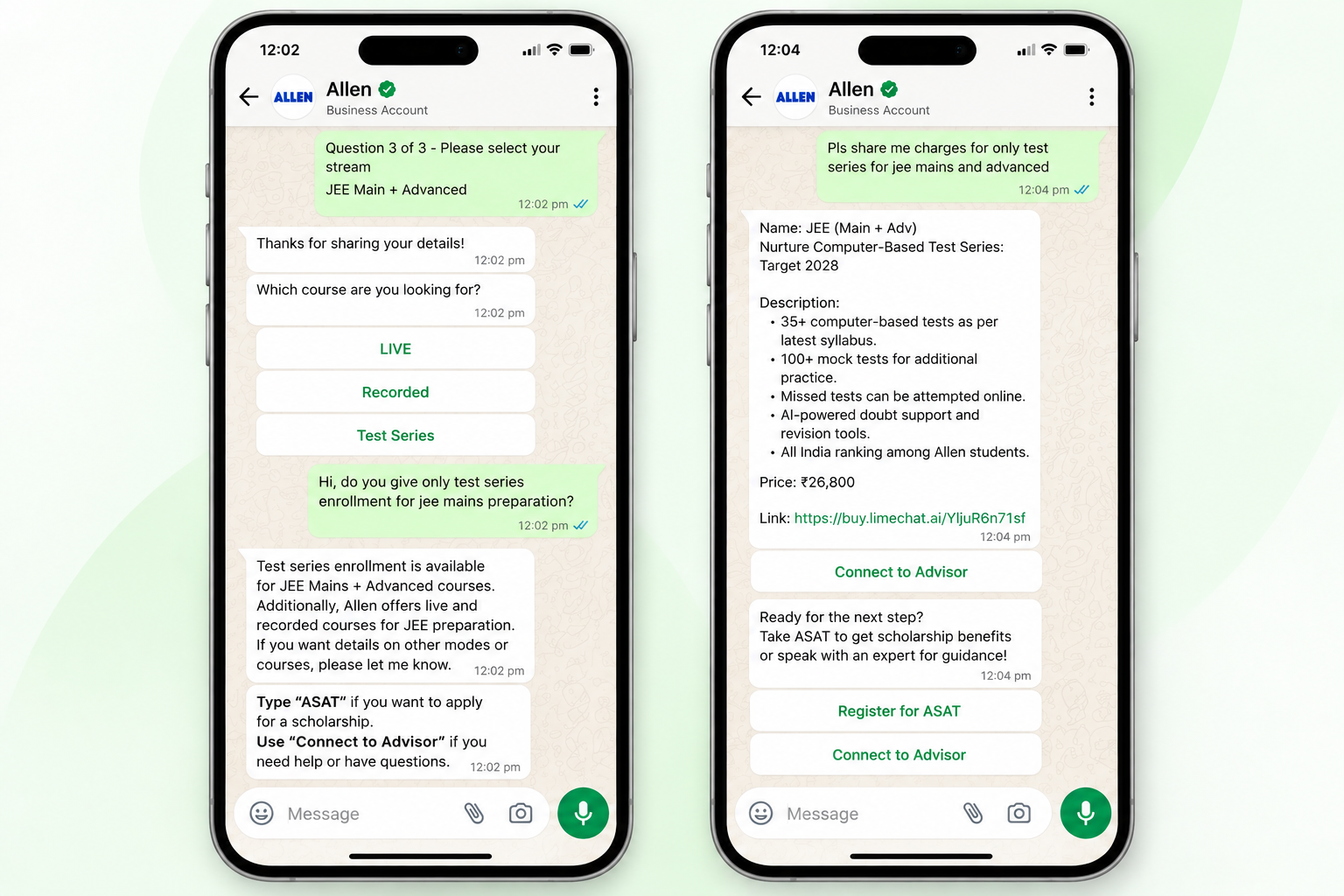
LimeChat placed a WhatsApp-native AI agent in front of Allen's inbound funnel, qualifying every lead before a counsellor ever sees it.
The agent engages every lead immediately, regardless of time of day or season, and captures class, stream, course interest, location and intent through natural conversation rather than a form. Leads that aren't ready yet are held in nurture rather than discarded. Only qualified leads are handed off to a counsellor, with the full conversation attached.
Four behaviours drive the funnel:
- Instant engagement: first response is decoupled from counsellor availability, including at peak admission season
- Upfront qualification: class, stream, course, geography and intent are captured in dialogue, not downstream on a call
- Personalised support: course, fee, batch, faculty, centre and brochure details are pulled live from Allen's own database, inside the chat
- Intelligent handoff: qualified leads route to a counsellor with full context attached, so the conversation opens on continuity rather than a cold start
Discovery ends at handoff, and closure begins there. The counsellor's role narrows back to what it was meant to be: enrolment, fee discussion, scholarships and exceptions.
How It's Built
The architecture splits cleanly along one line: deterministic logic wherever the answer is a fact, the LLM wherever the input is a student.
Deterministic logic handles course and batch lookups, fee structures, centre and timing availability, brochure retrieval, the qualification threshold itself, and counsellor routing with CRM write-back. Fee and eligibility information is always retrieved from Allen's live data, never generated.
The LLM is reserved for judgment: reading intent from free text, picking up readiness and urgency from how a student or parent writes, handling open-ended questions on course fit and preparation strategy, working through objections and hesitation, and processing multilingual input. Its job is to read the student; the deterministic layer decides what they're told and where they go.
Two Allen-owned systems sit behind the agent: a course and content database it reads from as the source of truth, and a CRM it writes to at the close of every conversation with lead attributes, the conversation log, the qualification outcome and the routing decision.
Guardrails and Handoff
Two rules govern the agent. The first keeps it inside admissions scope: out-of-scope questions are redirected with an explanation, competitor comparisons are declined and routed away, abusive or hostile interactions are terminated with a path to complaint resolution, and anything touching safety, identity or religion is blocked and escalated.
The second governs handoff to a human. A student or parent asking to be connected to a counsellor is routed immediately, with no deflection loop. So is any conversation that needs judgment the agent can't provide on its own: a qualified lead ready to enrol, fee negotiation or scholarship discussion, admission exceptions, or a question outside available data. In every case, the full conversation context travels with the handoff.
Where the agent is uncertain, it re-asks and narrows the question before attempting a second classification, rather than escalating immediately. Conversation-level logging, unanswered-query review and drop-off review all feed back into the flows on an ongoing basis.
Results
Automation is measured at the conversation level: a query counts as automated only when it resolves without a counsellor entering the thread at all, not merely receiving a fast first reply. On that basis, 80% of inbound queries now resolve without any counsellor involvement, freeing up meaningful capacity that used to go into calls that were never going to convert.
Cost per inbound lead has come down to 3× lower than the pre-deployment baseline, for the same ad spend and traffic mix. The mechanism behind both results is the same: qualifying at the top of the funnel means marketing spend stops being diluted by conversations that were never going to close.
What's Next
The nearest expansion is outbound and nurture, re-engaging earlier-stage students ahead of the next admission window. Voice is still unopened: a voice agent carrying chat context, so a conversation can move from chat to call and back without starting over. Post-enrolment is untouched territory too, from fee reminders and batch communication to attendance updates and renewal.
The same journey logic and the same course database mean that extending to new programmes, centres and geographies is a deployment, not a rebuild.
Conclusion
The agent sits in front, the counsellor sits behind. Qualification happens in conversation, before intent ever reaches a person, and the counsellor's time goes back to the part of the job only a person can do.

More Case Studies

.webp)
Transform your marketing and support today